
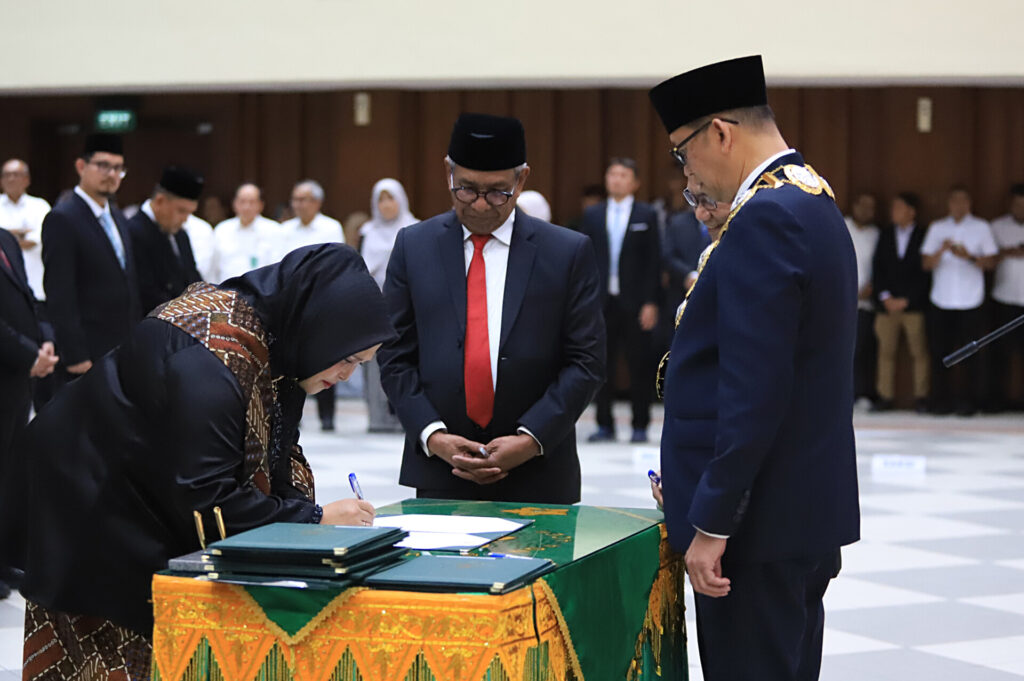
The Faculty of Dentistry (FKG) at Syiah Kuala University (USK) has entered a new leadership phase after USK Rector Prof. Dr. Mirza Tabrani, S.E., M.B.A., D.B.A., inaugurated Dr. drg. Zulfan M. Alibasyah, Sp. Perio as dean for the 2026–2031 term at the AAC Dayan Dawood Building in Banda Aceh on Monday, July 13, 2026.
The inauguration was part of the appointment of 12 deans and one Director of the Graduate Program at USK.
This leadership transition is more than just a rotation of academic positions. Zulfan brings an agenda of renewal that positions the USK School of Dentistry as an institution committed to strengthening the quality of education, accelerating innovation, expanding its international network, and building institutional autonomy amid increasingly fierce competition in higher education.
This direction is encapsulated in the vision “Excellence, Innovation, and Impact in ASEAN Dentopreneurship,” a concept that combines academic excellence with the ability to innovate, an entrepreneurial spirit, and a focus on tangible benefits for society.
This vision is also aligned with Syiah Kuala University’s goal of becoming an excellent, innovative, globally impactful, and sustainable institution of higher education by 2031.
In his inaugural speech, Zulfan said that a faculty’s transformation cannot be measured solely by the construction of new buildings or the addition of new programs.
According to him, transformation must begin with a shift in mindset, organizational culture, and the courage to make decisions based on data and future needs.
“The School of Dentistry must be an institution capable of anticipating change, driving innovation, and delivering tangible benefits. Education, research, and community service must all work toward the same goal: achieving internationally recognized quality,” he said.
He believes that the USK School of Dentistry has strong foundations for growth, ranging from human resources and teaching hospitals to Aceh’s biodiversity, which can be developed into flagship themes for dental research.
The next challenge is to align all of this potential with the needs of the community, the industry, and scientific advancements.
Therefore, the new leadership has established four key priorities. First, improving the quality of education through the implementation of an Outcome-Based Education (OBE) curriculum that aligns with international standards.
Second, strengthening research that goes beyond scientific publications to generate innovations and products that benefit society.
Third, accelerating the digitization of governance based on the principles of Good University Governance to make decision-making more transparent and measurable.
Fourth, building institutional autonomy through the development of partnership networks, the optimization of the Dental and Oral Health Hospital (RSGM), and the strengthening of academic business units.
As a first step, Zulfan established a 100-day work program focused on internal consolidation. This phase includes a comprehensive evaluation of the academic and organizational systems, OBE-based quality mapping, strengthening digital services, and establishing more collaborative working mechanisms with faculty, students, alumni, teaching hospitals, the business community, the government, and international partners.
According to him, improvements made in the early stages will serve as the foundation for implementing the agenda for the next five years, including the development of master’s programs and specialist dental education, increasing the number of faculty members with doctoral degrees and full professors, expanding international research collaborations, and strengthening the reputation of the USK School of Dentistry in the ASEAN region.
Zulfan emphasized that all of these programs are designed to support the achievement of Syiah Kuala University’s Key Performance Indicators, such as improving the quality of graduates, commercializing research outcomes, obtaining international accreditation, and increasing the university’s non-state budget revenue.
“The faculty cannot operate in isolation. All of our targeted achievements must contribute to the overall success of Syiah Kuala University. We want the Faculty of Dentistry to serve as one of the driving forces behind the university’s transformation,” he said.
He added that the measure of his leadership’s success is not the number of activities carried out, but rather the changes that are truly felt by the academic community and the public.
Through this development strategy, the USK School of Dentistry is embarking on a new phase that prioritizes innovation, collaboration, modern governance, and public benefit as the foundation for strengthening its position as one of the leading centers for dental education in Indonesia and the Southeast Asian region.