
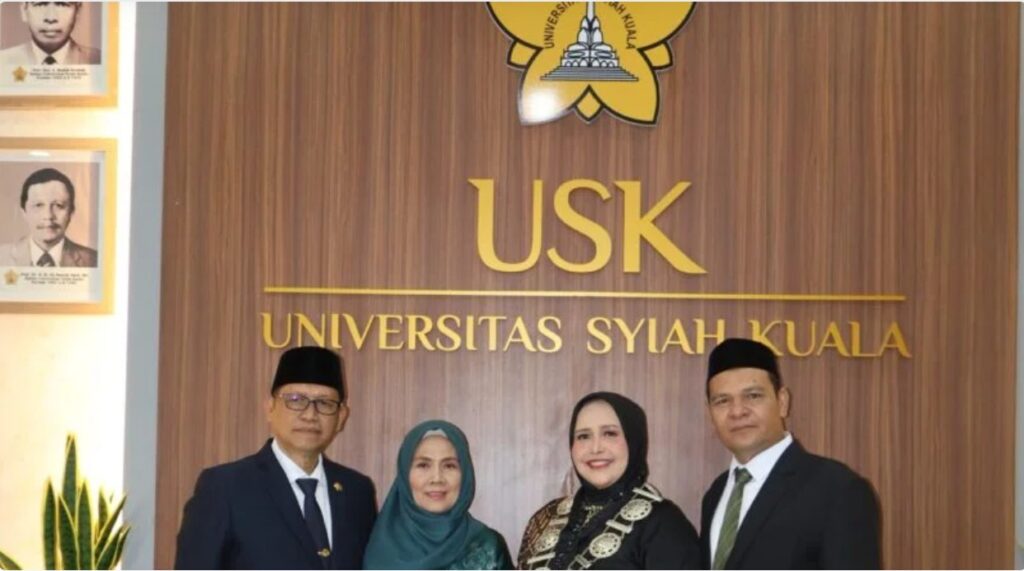
The Faculty of Dentistry (FKG) at Syiah Kuala University (USK) has begun shifting its development focus from being merely an educational institution to becoming a faculty capable of building an ecosystem of innovation and academic entrepreneurship. This initiative is one of the key priorities of the Dean of the USK FKG for the 2026–2031 term, Dr. drg. Zulfan M. Alibasyah, Sp.Perio, who was recently inaugurated by the USK Rector on Monday, July 13, 2026.
Early in his tenure, Zulfan launched the Dentistry USK Enterprise Initiative (DEI), a program designed to strengthen the faculty’s financial independence through the development of four academic business units integrated with education, research, and health services.
The four units include the Dental Continuing Education Center, the Disaster Dental Center, the Research Contract Unit, and the Digital Dentistry Center. All of them are designed to serve as spaces for collaboration between the university, the government, the business community, professional organizations, and international partners.
“It is not enough for universities to simply produce graduates. Universities must also be able to generate innovations that benefit society and create a sustainable source of revenue to support academic development,” said Zulfan on Tuesday, July 14, 2026.
According to him, the establishment of a business unit is not merely about pursuing financial gain, but serves as a means to accelerate the commercialization of faculty members’ research findings and expand the benefits of dental science to the public.
So far, he said, various studies on biomaterials, dental health, and the utilization of Aceh’s biodiversity have not yet fully developed into products or services with economic value.
Through its Research Contract Unit, the USK School of Dentistry will open opportunities for collaborative research with the government and the private sector. The school also aims to increase intellectual property rights and patents, and to develop innovative products that are ready for the market.
Meanwhile, the Dental Continuing Education Center is projected to become a center for continuing professional education for dentists, offering a variety of competency-building programs, including digital dentistry and implant dentistry.
On the other hand, the Disaster Dental Center will expand the capacity of the USK Faculty of Dentistry in the fields of forensic dentistry, disaster victim identification, and disaster response training. This program is considered relevant given Aceh’s experience as a region with a long history of facing natural disasters.
The Digital Dentistry Center is intended to serve as the faculty’s hub for digital transformation, ranging from the development of dental healthcare technologies to the incubation of innovations by students and alumni in the field of dental technology.
All of these programs are part of Zulfan’s first 100-day leadership agenda. In the initial phase, the faculty will conduct academic and organizational audits, strengthen the digital governance system, assess human resource readiness, and develop business models for each unit to ensure they operate in accordance with the principles of Good University Governance.
“We want to build the system first before launching the business. The governance foundation must be strong so that all units can grow sustainably,” he said.
To accelerate development, the USK Faculty of Dentistry will also conduct benchmarking visits to several universities that have successfully managed academic business units, including the Faculty of Dentistry at Airlangga University, the University of Indonesia, and the Center for Economic and Business Development at the Faculty of Economics and Business, Gadjah Mada University.
Zulfan believes that the success of this transformation cannot be achieved by the academic community alone. Therefore, he is calling on local governments, hospitals, the pharmaceutical industry, medical device companies, state-owned enterprises, the oil and gas sector, professional organizations, alumni, and educational institutions across the ASEAN region to build long-term partnerships with the USK School of Dentistry.
According to him, forms of cooperation can include joint research, technology development, training programs, investment in educational facilities, internship programs, and the hiring of graduates.
“We are opening up the widest possible scope for collaboration. The university must serve as a strategic partner for the business community and the government in producing beneficial innovations. We believe that synergy is the key to accelerating the development of an excellent and competitive dental education program at the ASEAN level,” said Zulfan.
He emphasized that the entire agenda is part of the vision of “Outstanding, Innovative, and Impactful ASEAN Dentopreneurs,” which integrates education, research, healthcare services, innovation, and entrepreneurship into a single faculty development ecosystem.
Through this strategy, the USK Faculty of Dentistry hopes not only to improve academic quality but also to strengthen the institution’s autonomy while expanding its contribution to knowledge-based health and economic development in Aceh and the Southeast Asian region.